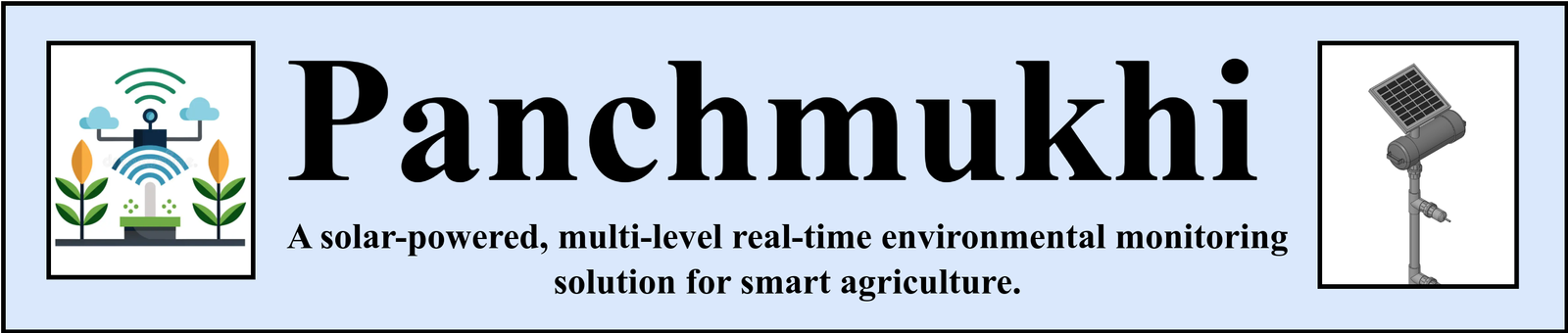
An advanced real-time environmental monitoring system has been developed at the ICAR-Indian Agricultural Research Institute (IARI), New Delhi, in collaboration with ICAR-Indian Agricultural Statistics Research Institute (IASRI), New Delhi. This system is installed in the field of the Agronomy Division at IARI and is powered by Internet of Things (IoT) technology. It uses eight high-precision sensors to continuously monitor the agricultural microenvironment. Among these, five sensors record temperature at different depths and heights: air temperature at 100 cm and 50 cm, and soil temperature at 15 cm, 30 cm, and 45 cm. The other three sensors measure moisture: air moisture at 100 cm and 50 cm, and surface soil moisture. All sensors are mounted on a dedicated sensor tower, which is equipped with a solar power unit for uninterrupted, autonomous operation even in remote fields. Sensor readings are recorded and transmitted to a centralized server at approximately 16-minute intervals, enabling near real-time monitoring. The system supports data storage, visualization, and analysis via a web-based interface, making it accessible from anywhere. Data is stored in structured formats and visualized through interactive graphs for temperature and moisture trends. The system’s design ensures low power consumption, wireless communication, and robust outdoor performance.
By continuously capturing field conditions, this setup helps researchers observe microclimatic variation, soil-plant-water interaction, and environmental stresses. It enables early detection of anomalies such as heat stress, excessive dryness, or unusual fluctuations in temperature or humidity. Researchers and farm managers can make timely decisions about irrigation, crop protection, and input management. The real-time data can also feed into decision support systems for precision agriculture. Since it is solar-powered and autonomous, this system can be replicated in remote and resource-limited agricultural zones. It supports sustainable farming by reducing reliance on manual observation and ensuring efficient use of water and energy. This innovation bridges the gap between on-field sensing and remote analytics, crucial for modern, data-driven agriculture. It exemplifies the integration of sensor technology, data science, and agronomy in real-world applications. Furthermore, it serves as a research platform for testing models, validating simulations, and conducting climate-resilient farming studies. Ultimately, the system has the potential to be scaled up and adapted for large-scale, multi-location agricultural monitoring across India.
Developed by:
ICAR - Indian Agricultural Statistics Research Institute (IASRI), New Delhi, India
ICAR - Indian Agricultural Research Institute (IARI), New Delhi, India